

By Matthew Hesselgrave, Coach
Quick note: This guide is educational and supportive. It doesn’t replace medical care. If you’re in crisis or experiencing suicidal thoughts, please reach out to local emergency services or your crisis line immediately.
Why a Visual Helps

If you live with bipolar disorder—or support someone who does—you know mood can feel like a tide: it rises, it falls, it has momentum. That’s why a simple picture can be powerful. In this guide, we use a sine wave (think of a smooth, curving line that rises and falls) to represent the natural rhythm of mood. Through the center of that wave runs a level line: your baseline, or “typical you.”
Around that baseline is a shaded area I call the regulation band. Inside this band, your strategies and willpower have the most leverage. Outside of it, as mood accelerates upward toward hypomania/mania or downward toward depression, biology tends to lead—and personal effort alone often isn’t enough.
The goal isn’t to control the entire wave. It’s to work skillfully where your effort counts most, while having a plan for the rest.
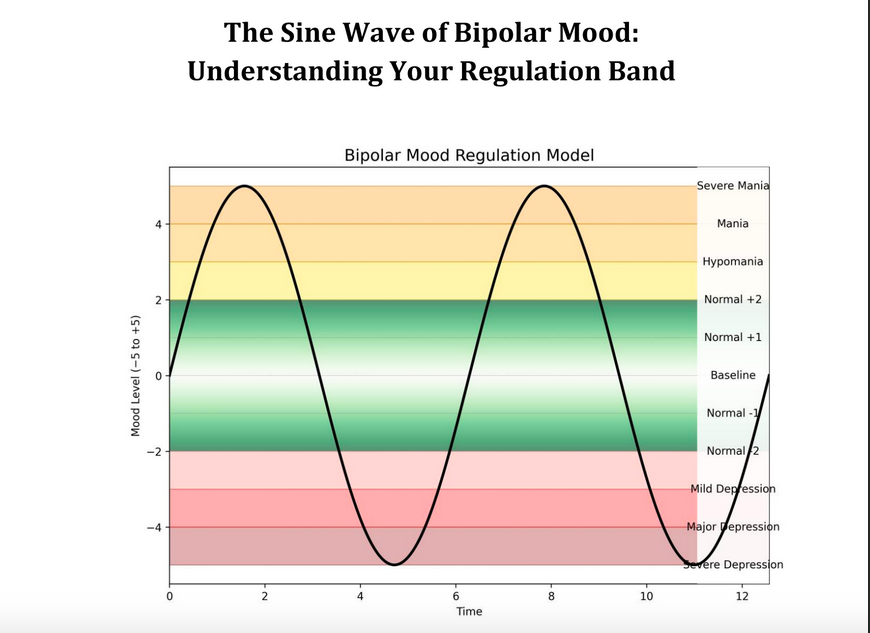
“Leverage is highest near baseline, and support matters most at the extremes.”
The 0–5 Mood Scale (Up and Down)
To make the model practical, we use a 0 to 5 scale in both directions from baseline:
0 = Baseline (stable, typical functioning)
+1 = Normal + (a little more energy and drive; still grounded)
+2 = Normal +2 (noticeably elevated; creativity and productivity up; mild impulsivity shows)
+3 = Hypomania (less sleep, more goal driven behavior, distracted, risk creeps in)
+4 = Mania (judgment impaired, pressured speech, significant risk taking)
+5 = Severe Mania (possible psychosis; requires urgent intervention)
On the downward side:
–1 = Normal – (lower energy, mild irritability, motivation dip)
–2 = Normal –2 (slowed thinking, withdrawal, noticeable functional impact)
–3 = Mild–Moderate Depression (persistent sadness, sleep/appetite changes, reduced capacity)
–4 = Major Depression (intense hopelessness, daily impairment, hard to initiate tasks)
–5 = Severe Depression (high risk, shutdown, clinical crisis—urgent help advised)
You can picture these as horizontal “mood levels” stacked from –5 at the bottom to +5 at the top, with your sine wave rising and falling through them over time.
The Regulation Band: Where Your Actions Matter Most
Here’s the heart of the model:
• Inside the band (about –2 to +2): your skills, routines, and supports can meaningfully nudge your mood back toward baseline. Think of it like steering a car on dry pavement—traction is good.
• Outside the band (–3 to –5, +3 to +5): mood becomes more biologically driven, and self correction through willpower is much harder. It’s like hitting ice—you still steer, but the car mostly slides unless you use special equipment (medical support, safety plans, crisis resources).
This isn’t a failure of character. It’s simply the physics of mood. When the wave is steep, momentum is stronger.
What to Do Inside the Band (–2 to +2)
These are practical strategies that give you traction when you’re close to baseline:
1. Protect Sleep Like a Superpower
Sleep is a directional lever. Less sleep tends to push upward; inconsistent sleep destabilizes both directions.
• Aim for a consistent schedule and winddown routine.
• Keep wake-up time steady; use light exposure in the morning.
2. Use Routines to Stabilize the Baseline
Regular mealtimes, movement, and meaningful activity scaffold your day. Routines reduce decision fatigue and prevent drift.
3. Tune Your Activity
• When you’re rising (+1 to +2), add structure and boundaries: limit multitasking, use timers, and say no to new commitments.
• When you’re falling (–1 to –2), increase support and gentle activation: small steps, low friction tasks, and compassionate pacing.
4. Grounding & Cognitive Skills
• 5 senses check-ins, paced breathing, and short mindfulness reps help regulate arousal.
-Thought labeling (“I’m having the thought that…”) creates mental space without arguing with your brain.
5. Medication Adherence & Check-ins
If you’re prescribed medication, consistency matters. Use reminders. If you notice early shift patterns (e.g., several shorter nights or persistent morning heaviness), message your provider early—inside the band.
What to Do Outside the Band (±3 to ±5)
When symptoms are strong, don’t white knuckle it. Your best moves are safety + support + medical alignment:
• Follow your care plan / crisis plan.
• Loop in your team (provider, therapist, coach, trusted person).
• Dial down risk: avoid big purchases, impulsive commitments, major life decisions.
• Prioritize safety: if you notice signs of psychosis, suicidal ideation, or inability to care for yourself, seek urgent help.
This is smart management—using the right tool for the right phase of the cycle.
Early Warning Signs: Catch the Wave Early
Most people can learn their personal “tells.” A few examples you can adapt:
• Upward drift tells (+1 to +2): sleeping later or less racing ideas, more jokes or tangents, extra tabs open, “just one more task” late at night, faster speech, grander plans.
• Downward drift tells (–1 to –2): morning heaviness, more sighing, scrolling without engagement, “I’ll do it later,” pulling back from people, small tasks feel heavier.
Pro tip: name your tells and post them somewhere you’ll see them. The earlier you respond, the easier it is to steer.
How to Use the Chart (Step by Step):
You can use the sine wave chart and the mood levels as a daily or weekly check-in:
1. Estimate your current level (–5 to +5). Don’t overthink it—use a gut feel and a few tells.
2. Check: am I inside the band? (–2 to +2) If yes: pick one small action from the band strategies.
3. If I’m outside the band:
• Activate your safety plan (e.g., message provider, adjust environment, enlist support).
• Reduce risk and complexity.
• Focus on sleep, meds, nutrition, hydration.
4. Track patterns, not perfection. The sine wave reminds you that fluctuation is normal. Your job is timely adjustments, not straight line control.
The sine wave is not a perfect scientific representation of bipolarity; it’s a helpful metaphor. Real life is lumpier. But the wave captures three truths:
1. Rhythm: moods often follow patterns over time.
2. Momentum: moving away from baseline increases slope (change happens faster).
3. Leverage: the flatter middle section is where small actions do the most good.
That’s why the regulation band is shaded across the mid-range: it’s your zone of influence. The farther you get from it, the more you rely on pre-planned supports and clinical tools.

Bipolar disorder isn’t about willpower. It’s about skill power plus support—applied at the right time, in the right way. On good days, keep your routines strong so they can carry you through wobblier days. On hard days, lean on your plan and your people. The sine wave will rise again; your job is to ride it safely, not to fight the ocean waves.
You do not have to navigate this on your own. We have current openings for coaching.